
Godzilla Melee Remastered Unlockables: What You Can Buy
Every unlockable category in Godzilla Melee Remastered: 12 monsters, 8 locations, gallery items and achievements, plus the fastest currency route.
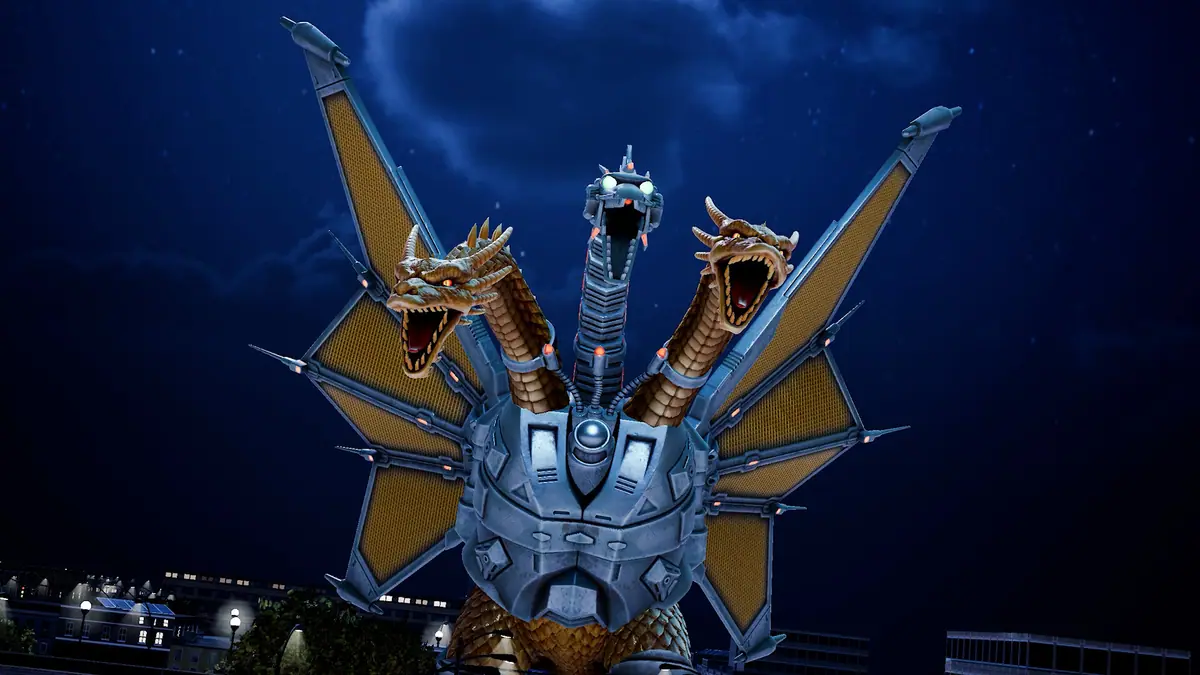
The remaster's unlockables are bought, not earned through a fixed campaign order. The official store description says the improved unlock system lets you get monsters, locations and gallery items in any order. That is the organising principle: play the modes you enjoy, earn currency, and spend it on the content you actually want.
That makes "unlockables" a broader question than "how do I unlock all monsters?". There are several categories, and they do not all cost the same or serve the same purpose. This page lists what is confirmed, what is not published, and the order that avoids wasting currency.
There are 12 playable monsters, 8 locations with day and night variants, gallery items and Steam achievements. Monsters and locations are purchased with in-game currency; you can buy them in any order. There is no pre-order exclusive fighter and no confirmed hidden 13th monster. For the full achievement list and the fastest route, see the 39-achievement guide.
The four unlockable categories
| Category | Confirmed content | How you get it | Published count |
|---|---|---|---|
| Monsters | The full playable roster | Buy with currency, any order | 12 |
| Locations | Arenas with day/night variants | Buy with currency, any order | 8 |
| Gallery items | Art, models and collectibles | Buy with currency or meet gallery objectives | Not published |
| Achievements | Steam achievements | Complete in-game tasks | Listed on Steam |
The important distinction is between currency unlocks and task unlocks. Monsters and locations are the currency side. Gallery items and achievements may also be tied to specific objectives, and the game does not publish a single master checklist. If you are a completionist, check the gallery screen after each session rather than assuming every item has a price.
Monsters: 12 slots, no hidden fighter
The launch roster is Godzilla, Godzilla 2000, Anguirus, Gigan, Megalon, King Ghidorah, Mecha-King Ghidorah, Mechagodzilla, Kiryu, Rodan, Destoroyah and Orga. The full roster page covers each fighter's identity and starter difficulty.
Three points are confirmed:
- Every fighter is purchasable. You do not have to clear a specific campaign to unlock a specific monster.
- The order is yours. The store description explicitly says monsters, locations and gallery items can be unlocked in any order.
- There is no pre-order exclusive. The 12-monster roster is the same on every platform.
Mothra is not playable. She appeared in the 2002 game as a non-playable imago and stage element, and the remaster's 12 slots are accounted for. Hedorah is also not a playable fighter. Treat "secret 13th monster" videos as unverified unless Atari announces one.
Locations: 8 arenas, 16 visual setups
The remaster has eight locations, each with a day and a night variant. The official material confirms three location types: recreated real-world cities, Monster Island and an alien Mothership. It does not publish a complete one-to-one list of every remaster stage, so a wiki list copied from the 2002 game is historical reference, not a confirmed remaster list.
Locations are bought with currency like monsters. The day/night variants are visual setups of the same arena, not separate purchases as far as Atari has said. The maps and arenas guide explains how each location type changes the neutral game.
Gallery items: the least documented category
The store description confirms gallery items as an unlock category. It does not publish:
- The total number of gallery items.
- Which items are currency purchases and which are objective rewards.
- Whether gallery completion unlocks anything else.
- Whether any gallery item is missable.
That is why the gallery is the category most likely to surprise a completionist. Check it regularly, and do not assume that a currency-only route will finish it. If an item has no price, look for an associated objective or milestone.
The unlock screen is the authority. A campaign clear, a local match or an online win may advance a gallery objective without announcing it on the results screen. A ten-second check prevents a later grind.
Achievements: separate from currency
Steam lists Steam Achievements as a feature. Achievements are not the same as gallery items: an achievement can be earned by doing something in a match, while a gallery item may be bought. The exact achievement list is on the Steam store page and in the game's achievement menu.
Do not confuse achievements with unlocks. Unlocking a monster does not necessarily unlock its achievement, and earning an achievement does not necessarily give you currency. Treat them as two separate checklists.
How currency is earned
The game does not publish a single "best" farming mode. The reliable sources are:
- Single-player campaigns. Each monster has a campaign, and completing matches pays currency. This is the structured route and the best way to learn a character.
- Local versus. Matches against friends or the CPU pay currency. If you have a second controller, this can be faster than repeated campaign clears because there is no story overhead.
- Online matches. Completed online matches pay currency. The amount may depend on the result and the mode, but the game does not require a win to progress as far as the store description shows.
- Gallery and challenge objectives. Some unlocks are tied to in-game achievements or gallery milestones. Check the gallery screen for tasks that pay currency or unlock items directly.
The safe habit is to finish matches rather than quitting. A completed match is the unit the game can reward; a quit is not.
A sensible unlock order
If you want to minimise wasted currency:
- Buy one main. Pick Godzilla, King Ghidorah or Mechagodzilla. These cover the basic archetypes and are forgiving enough to earn currency in any mode.
- Buy one counter. Pick a fighter that covers your main's bad matchup. If you play a zoner, buy a fast character who can pressure other zoners.
- Buy one location you like. You will spend a lot of time in the arena; a stage you enjoy is worth more than a fifth fighter you will not play.
- Fill the roster. Buy the remaining monsters once you know which playstyles you like.
- Finish the gallery. Save the least-documented category for last, when you already have a currency engine and know the objective structure.
This order is editorial advice, not an official progression rule. The game lets you ignore it completely.
What is not an unlockable
- No pre-order monster. The roster is the same on every platform.
- No retailer-exclusive fighter. There is no platform-specific character.
- No confirmed day-one DLC fighter. Atari has not announced one.
- No cheat code. If a video shows a secret input, it is showing a mod or a menu that is not in the retail build.
- No Mothra unlock. She is not one of the 12 playable monsters.
FAQ
How many monsters are unlockable? Twelve. The full roster is Godzilla, Godzilla 2000, Anguirus, Gigan, Megalon, King Ghidorah, Mecha-King Ghidorah, Mechagodzilla, Kiryu, Rodan, Destoroyah and Orga.
How many locations are there? Eight, each with a day and a night variant. The exact one-to-one stage list has not been fully published.
Can I unlock everything in any order? Monsters, locations and gallery items can be bought in any order according to the official store description. Some gallery items and achievements may be tied to objectives, so "any order" does not mean "no tasks".
Is there a secret 13th monster? No hidden fighter has been announced. The official roster reveal, store page and press material all say 12.
Do I need PlayStation Plus or Game Pass to unlock offline? No. Local play and campaign play do not require the platform's online subscription. Online PvP does.
Are gallery items missable? Not stated. The official material does not describe a missable gallery item or a recovery system. Check the gallery regularly and keep a manual save if you are worried.
Does unlocking a monster unlock its campaign? The campaign structure is per monster, but the official material does not describe a separate campaign unlock gate. Treat the roster purchase as the main gate and check the mode menu after buying.
What to read next
- How to unlock all monsters for the currency route and first purchases.
- Full roster and starters for the 12 fighters.
- Maps and arenas for the eight locations.
- Crossplay status before buying a second platform copy.
Sources
- Godzilla: Destroy All Monsters Melee Remastered on Steam — official unlock-system description and feature list.
- PlayStation Blog fighter guide — official 12-monster roster context.
- Atari — publisher announcements and support.
More Godzilla: Destroy All Monsters Melee Remastered Guides
How to play Destoroyah in the remaster: closing space, turning one opening into huge damage, and managing the commitment that makes him high-risk.
How to play Gigan in the remaster: buzzsaw pressure, chest laser zoning, movement mix-ups, and the defense you need to survive his small health pool.
How to play Godzilla 2000 in the remaster: the faster Godzilla's pressure game, spiral breath punishes, Rage timing, and the matchups where speed fails.
How to play Godzilla in the remaster: the neutral game, atomic breath timing, Rage Mode usage, and the matchups that punish careless beam spam.
How to play King Ghidorah in the remaster: using three heads and gravity beams to control space, when to stomp, and how to survive when a brawler gets inside.
How to play Kiryu in the remaster: the freeze tool, maser zoning, heavyweight normals, and the setup routes that make him the highest-ceiling monster.
How to play Mecha-King Ghidorah in the remaster: using cable traps and gravity beams to control space, and why the setup character is harder than King Ghidorah.
How to play the Showa Mechagodzilla in the remaster: armor trades, missile pressure, beam zoning, and the close-range weakness that keeps him honest.